SAMANTARAL: PARALLEL PATHS
Medium: Acrylic Paintings with gold leaf on Paper
Dimensions: Work_D1 & D2 – 21’x13”, Work_D3 – 24”x36”
Status: Was stopped in 2024. Currently working on the narrative and planning to remake the whole series again
Future Plans for Mediums and Materiality: Acrylic Gouache and gold leaf on 40”x40” and 24”X40” wooden panels
Abstract:
As a major part of my research and work revolves around narrative storytelling, mythology, South and South East Asian ethno cultural research, queer representation and hybridisation of human crisis; I slowly became more interested on the fact that, how narrative storytelling has affected human civilisation through ancient ages. And slowly, I’ve begun to write my own narratives in an allegorical and mystic way that brings up critical theories such as crisis of marginalisation. And Representation is a large part in this conversation. In other words, I’m making my own mythology that evokes conversations on these issues. This series is a 15 part painting series that tells the story of two lovers that ultimately acts as a mirror of the reality we try to hide every now and then behind the excuses of our culture, history and dignity. The self-proclaimed mythological paintings have their own part of storyline that I’m currently writing. This series explores the human thought process on different gender identities and gender role dynamics and questions various geographical, religious and political norms in an allegorical way. The title came forward as the storyline ends with the separation of the lovers due to societal norms while questioning the authorities.
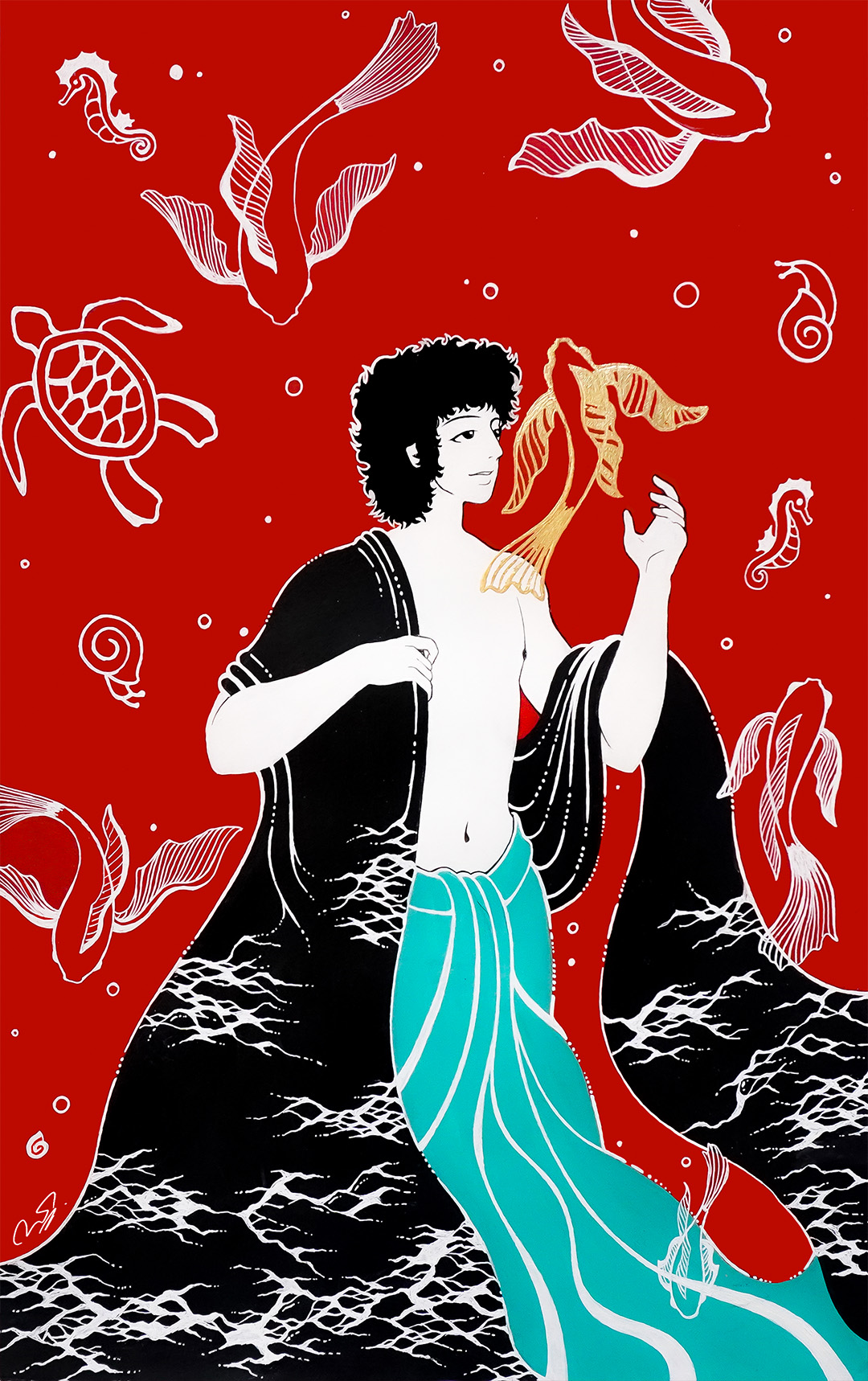
KUMBHA
Medium: Acrylic and Gold Leaf Collage on Paper
Kumbha, as his name, he holds a whole new world inside him. Sea God’s pearl of the eye; his dearest child, born from the very deep essence of the sea, is an absolute reservoir of calm water, filled with all the wisdom and patience of the world. A resilient spirit capable of withstanding any challenge while also having the power to shatter even the hardest of stones. From the start he has a soft and sedative nature, always interacting and amalgamating with the small energy flows of nature with his soul. He was infinite within himself but the manifestation of his soul didn’t inundate his physical body. Through time he roamed over the seas, never caring of the other world until the worlds merged and he came to know Syamantak. Little did he know that this encounter will bring drastic changes to his life?
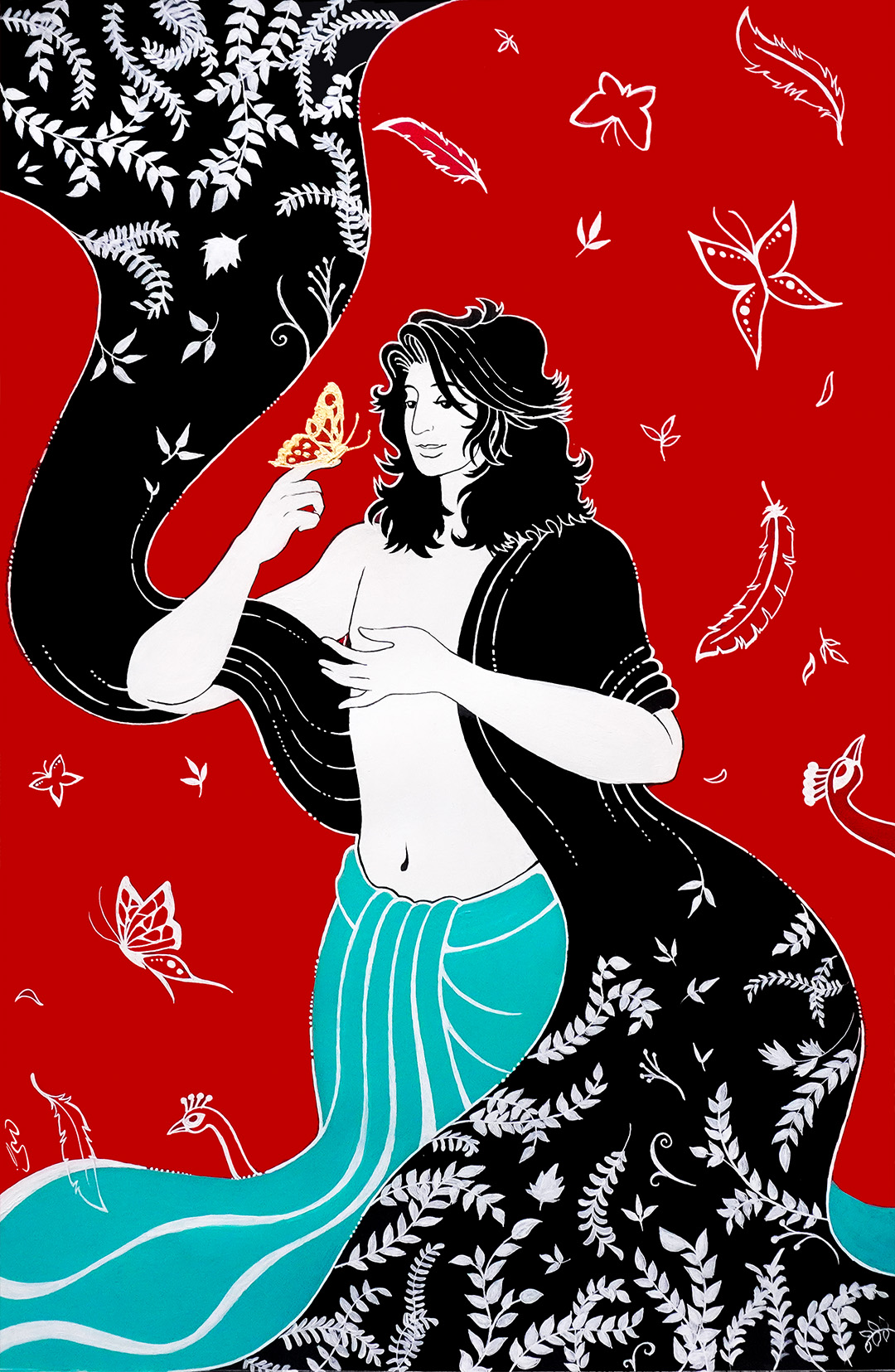
SYAMANTAK
Medium: Acrylic and Gold Leaf Collage on Paper
Syamantak, the shining firstborn of the earth king; his most precious hair; born with the blessings of Surya (Sun god) himself, is the epitome of energy and elegant demeanor. He is free, brave and full of life! A carefree new soul, born from the new energies that always wants to explore and experience the forces of the lands and nature. The little energy flows, the large structures, the elemental beauties, the flowing spirits, he thrived to experience all of these. While he was in an infinite exploration around land and skies in his world, it started merging with other worlds. As an overwhelmed Syamantak devouring the beauty of natural amalgamation his sharp and elegant eyes fell upon one soul, who he had never imagined would have the most profound influence on his life! He saw him! Kumbha!
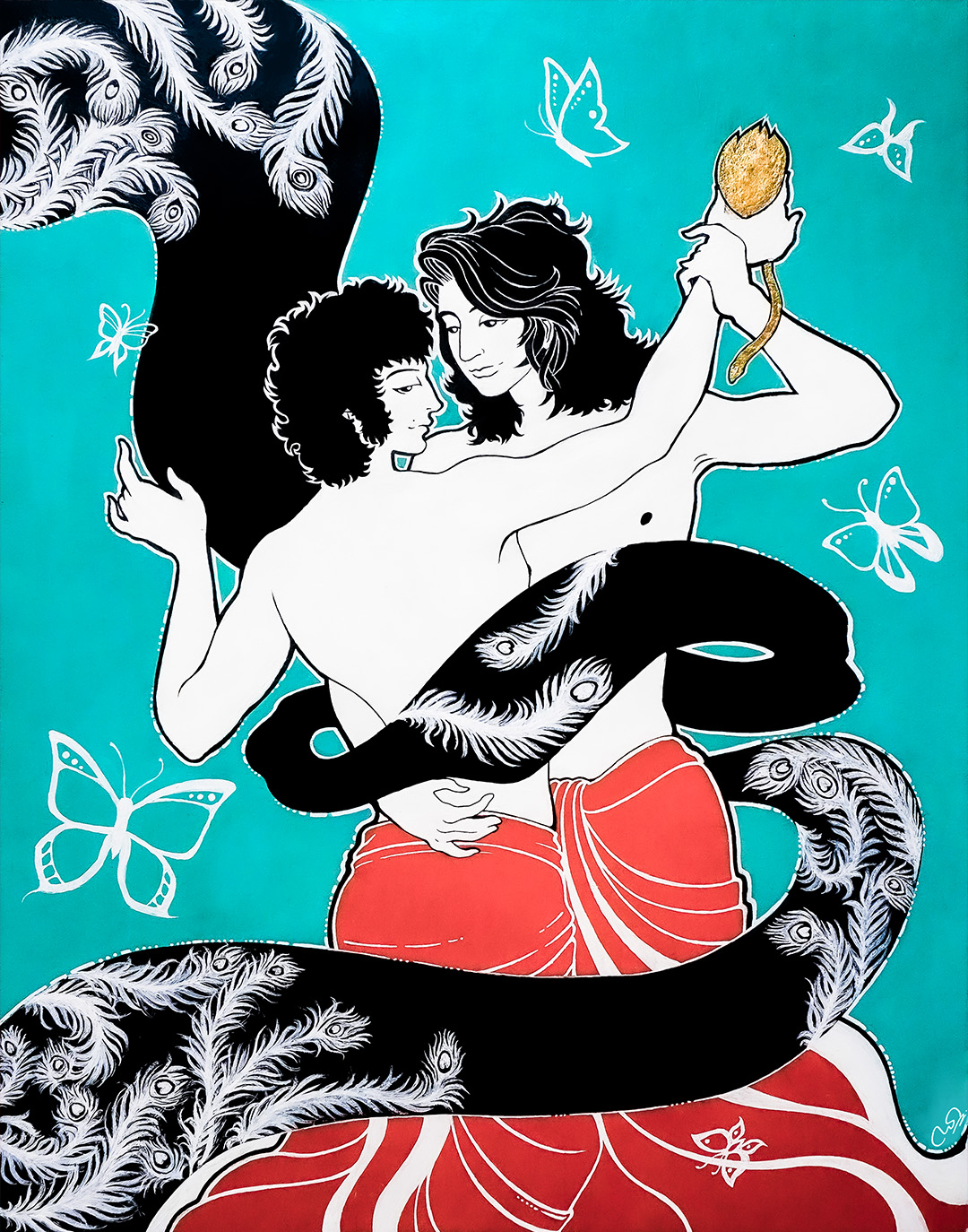
ATIMITRATA (INTIMACY)
Medium: Acrylic and Gold Leaf Collage on Paper
This is one of the storyline painting of the series. It is from a part where the two lovers are entangled in each other’s love and affection. The storyline building as well as the series is ongoing. Therefore the storyline of this painting will also be available as soon as the series will be completed or updated.
ARTIST'S NOTE: ANALYTICAL DEMOSTRATION
Mythology, to me, is a collection of stories that developed across different historical periods of human civilization. Through their interaction with human psychology, these narratives gradually gave rise to religions, belief systems, and cultural values. As societies expanded and populations grew, these mythological structures continued to influence social organization, collective consciousness, and even economic systems.
I believe art is not only a mirror of society and human consciousness but also a powerful tool capable of challenging and transforming existing perspectives. With this series, I wanted to explore the possibility of art acting as a key that can loosen social rigidity created by deeply rooted beliefs and religious sentiments. For that reason, I consciously chose not to remain minimal. Instead of expressing the concept through a single image, I developed a sequence of paintings that unfolds as a narrative. Storytelling became essential because the themes of transformation, attachment, desire, and social perception could not be contained within one isolated frame. Visually, I combined influences from older Asian and South Asian artistic traditions, particularly Thangka painting, Indian miniature painting and styles developed in Bengal School, with contemporary illustration practices and flat color applications. Rather than treating these traditions as separate visual languages, I attempted to allow them to coexist within the same narrative space.
One of the most important aspects of this series is its use of color. Since the story revolves around the breaking of conventional and stereotypical ideas surrounding relationships between two individuals, I deliberately rejected familiar color associations. Throughout the series, I assigned colors that appear unrelated or opposite to the subjects they represent. For example, in Character II: Syamantak, the character belongs to the earth and exists beneath the open sky. Conventionally, the sky would be represented through shades of blue. However, to reinforce the idea of disrupting accepted visual codes, I painted the sky in red. Similarly, in Character I: Kumbha, who emerges from the sea, I replaced the expected blue of water with red. In both cases, the color choices function as visual acts of resistance against established expectations. The same principle extends to the paintings that depict attraction, intimacy, affection, desire, and love. Red is perhaps the most widely accepted color associated with these emotions. To challenge that convention, I replaced red with green and blue tonalities in the backgrounds. Since the relationship portrayed in the series is often perceived as unconventional, unnatural, or socially unrecognized, I chose colors that stand in opposition to traditional visual codes of romance. The colors themselves become a metaphor for a love that exists outside accepted norms.
The recurring black cloak that appears throughout the series is another significant element. It symbolizes the attachment that binds the two characters together. The question often arises: why black? Through my own observations, I realized that white is frequently treated as a universal symbol of goodness, purity, and positivity. However, much of that symbolism emerges from specific cultural histories and later became normalized through dominant Western visual traditions. Within many South Asian contexts, black does not necessarily signify evil or negativity. Figures such as Mahakaal embody blackness while simultaneously representing divinity, power, and protection. Historically, black has often held meanings that are far more complex than simple moral opposition. Yet over time, external visual and cultural influences have reshaped how these symbols are commonly interpreted.
In this series, the relationship between the two characters is natural, affectionate, and deeply human, yet it is frequently judged as immoral, unnatural, or wrong. By representing their bond through black, I deliberately reverse those imposed assumptions. Here, black becomes a symbol of warmth, intimacy, beauty, protection, and positive energy. It represents the authenticity of their connection rather than the prejudices projected onto it.